The complete guide to bike rental in Berlin 2026
The complete guide to bike rental in Berlin 2026
The complete guide to bike rental in Berlin 2026
The complete guide to bike rental in Berlin 2026
Berlin is one of Europe's most bike-friendly capitals, with over 1,000 kilometres of cycling routes weaving through its neighbourhoods. If you're moving to the city or visiting for a few weeks, figuring out how to get a bike rental in Berlin can feel like a maze of apps, docking stations, and fine print. This guide breaks down every option, from hourly dockless rentals to monthly subscriptions, so you can pick the one that fits your schedule, budget, and riding style.
Berlin is one of Europe's most bike-friendly capitals, with over 1,000 kilometres of cycling routes weaving through its neighbourhoods. If you're moving to the city or visiting for a few weeks, figuring out how to get a bike rental in Berlin can feel like a maze of apps, docking stations, and fine print. This guide breaks down every option, from hourly dockless rentals to monthly subscriptions, so you can pick the one that fits your schedule, budget, and riding style.

Published
Published
Key Takeaways: Bike Rental in Berlin
Berlin offers hourly bikesharing, daily tourist rentals, and monthly bike subscriptions, each suited to different lengths of stay.
Dockless bikesharing apps let you unlock bikes on the spot, but per-minute costs add up quickly for daily commuters.
Traditional rental shops near tourist hubs charge by the day, making them practical for short sightseeing trips only.
Swapfiets includes free repairs, theft coverage options, and a fixed monthly fee, which removes surprise costs for regular riders.
Choosing between rental and subscription depends on how many days per month you plan to ride and how long you're staying.
What types of bike rental exist in Berlin?
Berlin's cycling landscape splits into three main categories: dockless bikesharing, traditional rental shops, and subscription services. Each category targets a different type of rider, from tourists spending a weekend to students commuting daily for an entire semester.
Dockless bikesharing lets you grab a bike from the street via an app and drop it off when you're done. Traditional shops rent out bikes by the hour or day, usually from a fixed shopfront. Subscription services hand you a personal bike for a monthly fee and handle repairs as part of the deal.
Understanding these three models is the first step to making a smart choice. The sections below dig into each one with real details about how they work, what they cost in broad terms, and who benefits most.
Dockless Bikesharing in Berlin
Dockless bikesharing is the grab-and-go option. You download an app, locate a nearby bike on the map, scan a QR code, and ride. When you're done, you lock the bike and leave it in a designated parking zone.
This model works when you need a bike for a single trip across town or a quick errand. The per-minute pricing structure keeps short rides affordable, but costs climb if you ride for an hour or more each day.
Availability can also be unpredictable. During rush hours or around popular stations, you might not find a bike nearby. And because the fleet is shared, the condition of each bike varies from ride to ride.
Traditional Bike Rental Shops in Berlin
Brick-and-mortar rental shops are scattered across Berlin's tourist corridors, especially in Mitte, Kreuzberg, and Prenzlauer Berg. You walk in, show an ID or leave a deposit, and ride off on a bike for the day.
Daily rates are straightforward, and shops often include a lock and a basic city map. Some offer guided tours as an add-on. For a weekend of sightseeing, this is one of the simplest ways to get on two wheels.
The drawback is flexibility. You'll need to return the bike to the same shop by closing time, and extending your rental usually means paying another full day's rate. For stays longer than a few days, the daily cost adds up quickly.
Monthly Bike Subscriptions in Berlin
A bike subscription gives you a personal bike assigned to you for as long as you need it. You pay a fixed amount each month, and the subscription typically includes maintenance, repairs, and sometimes theft support.
This model removes the daily calculation of rental costs. You know exactly what you'll pay, and you always have a bike ready at your door. For anyone staying in Berlin for a month or longer, subscriptions tend to be the most cost-effective and hassle-free route.
Swapfiets pioneered this model in Europe and currently serves over 280,000 members across multiple cities, including Berlin. The subscription covers free repairs and quick bike swaps if something can't be fixed on the spot.
How does bike rental compare to a bike subscription?
The core difference comes down to commitment and convenience. Rentals (hourly or daily) are pay-as-you-go. Subscriptions are pay-once-per-month and ride whenever you want. Each approach has a clear sweet spot.
If you're in Berlin for under a week, a daily rental or bikesharing trip makes financial sense. You pay only for the days you ride, and you don't need to think about ongoing costs after you leave.
If you're staying a month or more, the math shifts. Daily rental fees multiplied by 20 or 30 riding days typically exceed a monthly subscription fee, and the subscription includes perks like maintenance that you'd otherwise have to arrange yourself.
Cost Breakdown: Short-Term Rental vs. Subscription
Bikesharing apps in Berlin charge per-minute rates that vary by provider. A 30-minute ride can cost between one and four euros depending on the service and time of day. Ride twice a day for a month and you're looking at a significant total.
Traditional rental shops charge daily rates that are lower per hour than bikesharing but still accumulate. A week-long rental typically costs more than a single month of a bike subscription.
With Swapfiets, the Deluxe 7 pedal bike starts at a fixed monthly fee that includes all standard repairs, a double lock, and LED lights. The Power 1 and Power 7 e-bikes offer electric assistance for a higher monthly rate, still covering full maintenance.
Maintenance and Repairs: Who Handles What?
With hourly or daily rentals, maintenance is the rental company's problem while you have the bike. But if something breaks mid-ride, your options are limited. Most bikesharing apps ask you to report the issue and grab another bike.
Traditional shops generally expect you to return the bike in the condition you received it. Any damage beyond normal wear may come with a surcharge.
Subscriptions flip this around. Swapfiets handles everything from flat tyres to brake adjustments at no extra charge. If a repair takes longer than 10 minutes, they swap your bike for a working one on the spot, either in-store or at your doorstep. That reliability is one reason the Swapfiets bike range works well for daily commuters.
Flexibility and cancellation policies
Bikesharing is the most flexible: no contract, no cancellation, pay per ride. Traditional rentals ask for a deposit and a return time but no ongoing commitment.
Bike subscriptions require a notice period, typically one month. Swapfiets offers flexible, 6-month, and 12-month subscription options in Germany. The flexible subscription lets you cancel anytime with one month's notice, while loyal plans lock in a lower monthly rate.
For students on semester-length stays, a 6-month plan often hits the right balance between monthly savings and the freedom to leave when the term ends.
How to rent a bike in Berlin step by step
Getting a bike in Berlin is straightforward regardless of which model you choose. Below is a step-by-step walkthrough for each rental type so you can get rolling on your first day.
How to use dockless Bikesharing Apps
Download the bikesharing app of your choice from the App Store or Google Play. Create an account, add a payment method (credit card or PayPal), and verify your identity if prompted.
Open the app's map to find available bikes near you. Walk to the bike, scan the QR code on the handlebars or frame, and the lock releases automatically. Ride to your destination, park in an approved zone, and lock the bike through the app.
Check the fare before you start. Some providers offer day passes or ride bundles that reduce the per-minute cost if you plan multiple trips.
How to rent from a traditional Bike Shop
Search online for rental shops near your accommodation. Shops in central districts like Mitte and Friedrichshain tend to have the widest selection. Walk in during opening hours and bring a valid photo ID.
The shop will ask for a deposit (usually held on your credit card) and let you choose from available bikes. Test the brakes, adjust the seat height, and confirm the return time before you leave. According to visitBerlin's cycling guide, the city is increasingly welcoming to cyclists, with expanding infrastructure making it easier to explore by bike.
Return the bike on time to avoid extra charges. Most shops close by early evening, so plan your route accordingly.
How to start a bike subscription with Swapfiets
Visit the Swapfiets Berlin page and pick your bike model. Choose between the Deluxe 7 pedal bike, the Power 1 e-bike, or the Power 7 e-bike, depending on your commute distance and preference for electric assistance.
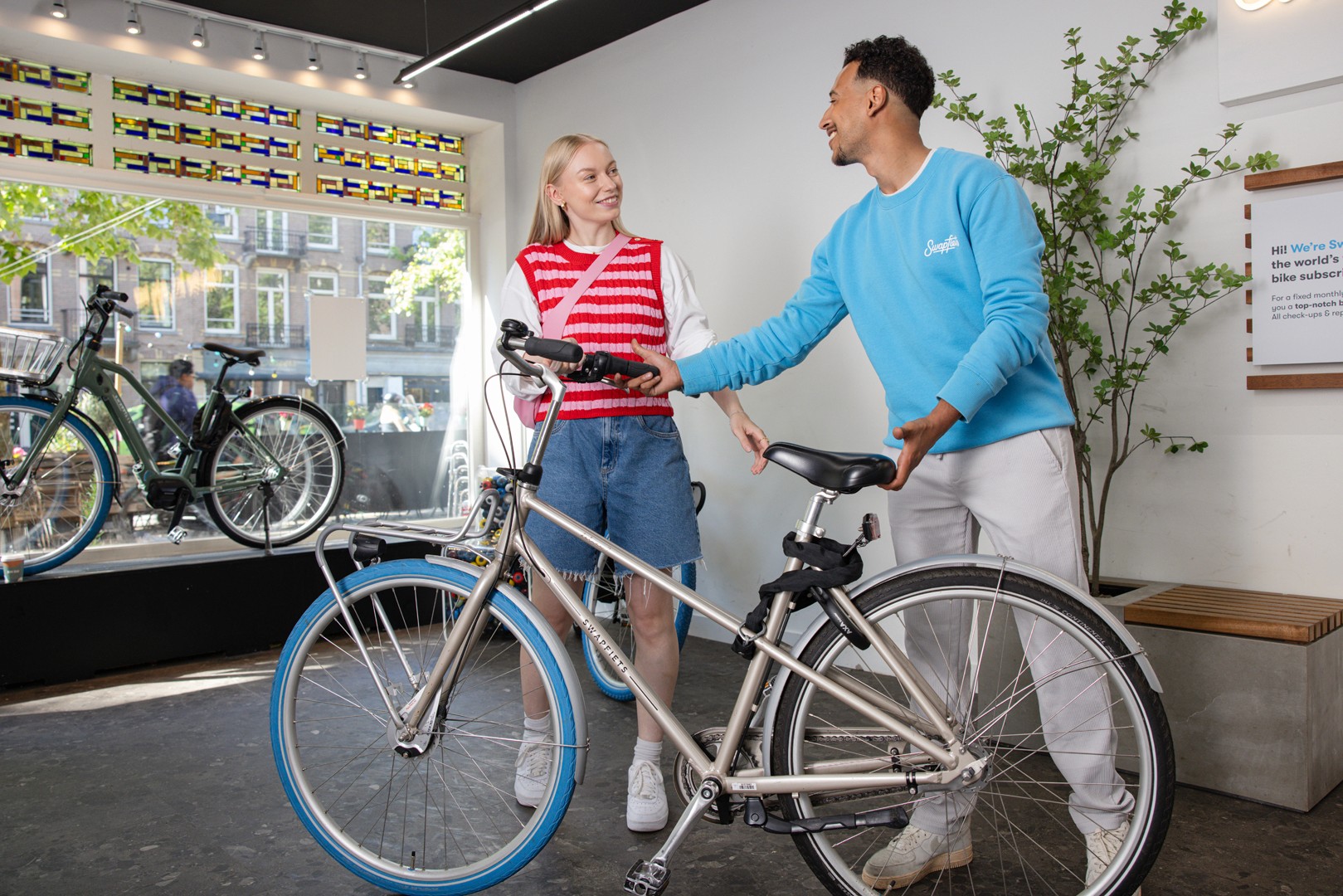
Select your subscription type (flexible, 6-month, or 12-month) and complete the online signup. You can pick up your bike at a Swapfiets store in Berlin, where the team adjusts the saddle height, brakes, and handlebars to your fit. Delivery to your doorstep is also available in Berlin's service area.
Once you have your bike, download the Swapfiets app. Through the app, you can book repair appointments, track your invoices, and manage your subscription. If anything breaks, report it in the app and the Swapfiets team will sort it out, often the same day.
What to consider when choosing a bike in Berlin
Not every bike suits every rider. Berlin is flat in many areas, but some neighbourhoods have gentle hills and cobblestone streets. Your riding style, storage situation, and commute length should all factor into your decision.
Pedal Bike vs. e-Bike in Berlin
Berlin's relatively flat terrain means a standard pedal bike covers most commutes without breaking a sweat. The Deluxe 7 from Swapfiets has 7 gears, which is more than enough for bridges, headwinds, and the occasional hill in areas like Prenzlauer Berg.
An e-bike makes sense if your daily commute exceeds 10 kilometres or you regularly carry heavy bags. Swapfiets e-bikes assist up to 25 km/h, cutting travel time on longer routes. The Power 7 offers a battery range of up to 150 km per charge, so you won't need to recharge daily.
Bike security and theft prevention
Bike theft is a real concern in Berlin. Every Swapfiets bike comes with a built-in double lock, and e-bikes include a separate battery lock. Always double-lock your bike to a fixed object, even for quick stops.
For extra peace of mind, Swapfiets offers Full Theft Coverage and Basic Theft Coverage options. If your double-locked bike is stolen, Swapfiets helps you file a police report and gets you a replacement bike quickly.
Berlin's cycling Infrastructure and routes
Berlin has been expanding its cycling network for years, though progress has been uneven. The city's Mobility Act (Mobilitätsgesetz) committed to building a connected network of protected bike lanes, and new routes continue to appear across districts like Friedrichshain-Kreuzberg and Neukölln. The nonprofit Changing Cities tracks the progress of Berlin's cycling network and publishes regular updates on completed and planned routes.
Key cycling corridors include the paths along the Spree river, the former Berlin Wall trail (Berliner Mauerweg), and the ring of routes connecting major train stations. Bike lanes on busy streets like Karl-Marx-Allee and Kottbusser Damm give you dedicated space away from car traffic.
Who should choose a rental and who should choose a subscription?
Your length of stay is the single biggest factor. Below is a quick breakdown by rider profile.
Short-term visitors (1 to 7 days)
If you're in Berlin for a holiday or a business trip, a daily rental from a shop or a bikesharing app is the most practical choice. You avoid monthly commitments, and you can try different areas of the city without worrying about where to store a bike overnight.
Medium-term visitors (2 weeks to 3 months)
For stays of two weeks or more, daily rental costs start to outpace a subscription. A flexible month-to-month subscription from Swapfiets keeps your riding costs predictable and gives you a reliable bike waiting at home every morning.
This is also the sweet spot for interns, short-term project workers, and language course students who need an efficient daily commute but don't want to buy a bike.
New residents and long-term students
If you're settling in Berlin for a semester or longer, a 6-month or 12-month subscription locks in the lowest monthly rate. You get an assigned bike that's always maintained, and you skip the hassle of buying a used bike that might need expensive repairs. Students can access a discount at checkout, bringing the monthly cost down even further.
Swapfiets also runs a referral programme (Friends with Benefits), where you and a friend both save when they sign up through your link. For students building a new social circle in Berlin, this is a practical bonus.
Common mistakes to avoid when renting a bike in Berlin
A few easily avoidable errors trip up newcomers. Being aware of them saves you time and money.
Ignoring the fine print on Bikesharing Apps
Some bikesharing apps charge unlock fees on top of per-minute rates. Others have restricted parking zones, and leaving a bike outside those zones triggers a penalty. Read the app's pricing page and parking map before your first ride.
Skipping bike Insurance or theft coverage
Berlin has one of the highest bike theft rates in Germany. Riding without any form of theft protection is a risk, especially if you leave your bike outside overnight. If you rent from a shop, ask about their theft policy. With a Swapfiets subscription, you can add theft coverage directly through your plan.
Choosing the wrong bike size or type
A bike that doesn't fit leads to sore knees, back pain, and slower rides. When picking up from a rental shop, take a moment to adjust the saddle and test the brakes. With Swapfiets, the in-store team fits the bike to your height (optimised for riders 160 to 200 cm) and explains every feature before you ride off.
In Conclusion: How to Pick the Right Bike Rental in Berlin
Berlin gives you plenty of ways to get on two wheels. For quick visits, bikesharing and daily rentals do the job. For stays of a month or more, a subscription from Swapfiets saves you money, removes maintenance headaches, and puts a reliable, well-maintained bike at your door.
Think about how often you'll ride, how long you're staying, and how much hassle you're willing to handle. Then pick the option that matches. If you're staying longer than a few weeks and want worry-free biking, starting a Swapfiets membership in Berlin is the most straightforward path to daily cycling in the city.
Key Takeaways: Bike Rental in Berlin
Berlin offers hourly bikesharing, daily tourist rentals, and monthly bike subscriptions, each suited to different lengths of stay.
Dockless bikesharing apps let you unlock bikes on the spot, but per-minute costs add up quickly for daily commuters.
Traditional rental shops near tourist hubs charge by the day, making them practical for short sightseeing trips only.
Swapfiets includes free repairs, theft coverage options, and a fixed monthly fee, which removes surprise costs for regular riders.
Choosing between rental and subscription depends on how many days per month you plan to ride and how long you're staying.
What types of bike rental exist in Berlin?
Berlin's cycling landscape splits into three main categories: dockless bikesharing, traditional rental shops, and subscription services. Each category targets a different type of rider, from tourists spending a weekend to students commuting daily for an entire semester.
Dockless bikesharing lets you grab a bike from the street via an app and drop it off when you're done. Traditional shops rent out bikes by the hour or day, usually from a fixed shopfront. Subscription services hand you a personal bike for a monthly fee and handle repairs as part of the deal.
Understanding these three models is the first step to making a smart choice. The sections below dig into each one with real details about how they work, what they cost in broad terms, and who benefits most.
Dockless Bikesharing in Berlin
Dockless bikesharing is the grab-and-go option. You download an app, locate a nearby bike on the map, scan a QR code, and ride. When you're done, you lock the bike and leave it in a designated parking zone.
This model works when you need a bike for a single trip across town or a quick errand. The per-minute pricing structure keeps short rides affordable, but costs climb if you ride for an hour or more each day.
Availability can also be unpredictable. During rush hours or around popular stations, you might not find a bike nearby. And because the fleet is shared, the condition of each bike varies from ride to ride.
Traditional Bike Rental Shops in Berlin
Brick-and-mortar rental shops are scattered across Berlin's tourist corridors, especially in Mitte, Kreuzberg, and Prenzlauer Berg. You walk in, show an ID or leave a deposit, and ride off on a bike for the day.
Daily rates are straightforward, and shops often include a lock and a basic city map. Some offer guided tours as an add-on. For a weekend of sightseeing, this is one of the simplest ways to get on two wheels.
The drawback is flexibility. You'll need to return the bike to the same shop by closing time, and extending your rental usually means paying another full day's rate. For stays longer than a few days, the daily cost adds up quickly.
Monthly Bike Subscriptions in Berlin
A bike subscription gives you a personal bike assigned to you for as long as you need it. You pay a fixed amount each month, and the subscription typically includes maintenance, repairs, and sometimes theft support.
This model removes the daily calculation of rental costs. You know exactly what you'll pay, and you always have a bike ready at your door. For anyone staying in Berlin for a month or longer, subscriptions tend to be the most cost-effective and hassle-free route.
Swapfiets pioneered this model in Europe and currently serves over 280,000 members across multiple cities, including Berlin. The subscription covers free repairs and quick bike swaps if something can't be fixed on the spot.
How does bike rental compare to a bike subscription?
The core difference comes down to commitment and convenience. Rentals (hourly or daily) are pay-as-you-go. Subscriptions are pay-once-per-month and ride whenever you want. Each approach has a clear sweet spot.
If you're in Berlin for under a week, a daily rental or bikesharing trip makes financial sense. You pay only for the days you ride, and you don't need to think about ongoing costs after you leave.
If you're staying a month or more, the math shifts. Daily rental fees multiplied by 20 or 30 riding days typically exceed a monthly subscription fee, and the subscription includes perks like maintenance that you'd otherwise have to arrange yourself.
Cost Breakdown: Short-Term Rental vs. Subscription
Bikesharing apps in Berlin charge per-minute rates that vary by provider. A 30-minute ride can cost between one and four euros depending on the service and time of day. Ride twice a day for a month and you're looking at a significant total.
Traditional rental shops charge daily rates that are lower per hour than bikesharing but still accumulate. A week-long rental typically costs more than a single month of a bike subscription.
With Swapfiets, the Deluxe 7 pedal bike starts at a fixed monthly fee that includes all standard repairs, a double lock, and LED lights. The Power 1 and Power 7 e-bikes offer electric assistance for a higher monthly rate, still covering full maintenance.
Maintenance and Repairs: Who Handles What?
With hourly or daily rentals, maintenance is the rental company's problem while you have the bike. But if something breaks mid-ride, your options are limited. Most bikesharing apps ask you to report the issue and grab another bike.
Traditional shops generally expect you to return the bike in the condition you received it. Any damage beyond normal wear may come with a surcharge.
Subscriptions flip this around. Swapfiets handles everything from flat tyres to brake adjustments at no extra charge. If a repair takes longer than 10 minutes, they swap your bike for a working one on the spot, either in-store or at your doorstep. That reliability is one reason the Swapfiets bike range works well for daily commuters.
Flexibility and cancellation policies
Bikesharing is the most flexible: no contract, no cancellation, pay per ride. Traditional rentals ask for a deposit and a return time but no ongoing commitment.
Bike subscriptions require a notice period, typically one month. Swapfiets offers flexible, 6-month, and 12-month subscription options in Germany. The flexible subscription lets you cancel anytime with one month's notice, while loyal plans lock in a lower monthly rate.
For students on semester-length stays, a 6-month plan often hits the right balance between monthly savings and the freedom to leave when the term ends.
How to rent a bike in Berlin step by step
Getting a bike in Berlin is straightforward regardless of which model you choose. Below is a step-by-step walkthrough for each rental type so you can get rolling on your first day.
How to use dockless Bikesharing Apps
Download the bikesharing app of your choice from the App Store or Google Play. Create an account, add a payment method (credit card or PayPal), and verify your identity if prompted.
Open the app's map to find available bikes near you. Walk to the bike, scan the QR code on the handlebars or frame, and the lock releases automatically. Ride to your destination, park in an approved zone, and lock the bike through the app.
Check the fare before you start. Some providers offer day passes or ride bundles that reduce the per-minute cost if you plan multiple trips.
How to rent from a traditional Bike Shop
Search online for rental shops near your accommodation. Shops in central districts like Mitte and Friedrichshain tend to have the widest selection. Walk in during opening hours and bring a valid photo ID.
The shop will ask for a deposit (usually held on your credit card) and let you choose from available bikes. Test the brakes, adjust the seat height, and confirm the return time before you leave. According to visitBerlin's cycling guide, the city is increasingly welcoming to cyclists, with expanding infrastructure making it easier to explore by bike.
Return the bike on time to avoid extra charges. Most shops close by early evening, so plan your route accordingly.
How to start a bike subscription with Swapfiets
Visit the Swapfiets Berlin page and pick your bike model. Choose between the Deluxe 7 pedal bike, the Power 1 e-bike, or the Power 7 e-bike, depending on your commute distance and preference for electric assistance.
Select your subscription type (flexible, 6-month, or 12-month) and complete the online signup. You can pick up your bike at a Swapfiets store in Berlin, where the team adjusts the saddle height, brakes, and handlebars to your fit. Delivery to your doorstep is also available in Berlin's service area.
Once you have your bike, download the Swapfiets app. Through the app, you can book repair appointments, track your invoices, and manage your subscription. If anything breaks, report it in the app and the Swapfiets team will sort it out, often the same day.
What to consider when choosing a bike in Berlin
Not every bike suits every rider. Berlin is flat in many areas, but some neighbourhoods have gentle hills and cobblestone streets. Your riding style, storage situation, and commute length should all factor into your decision.
Pedal Bike vs. e-Bike in Berlin
Berlin's relatively flat terrain means a standard pedal bike covers most commutes without breaking a sweat. The Deluxe 7 from Swapfiets has 7 gears, which is more than enough for bridges, headwinds, and the occasional hill in areas like Prenzlauer Berg.
An e-bike makes sense if your daily commute exceeds 10 kilometres or you regularly carry heavy bags. Swapfiets e-bikes assist up to 25 km/h, cutting travel time on longer routes. The Power 7 offers a battery range of up to 150 km per charge, so you won't need to recharge daily.
Bike security and theft prevention
Bike theft is a real concern in Berlin. Every Swapfiets bike comes with a built-in double lock, and e-bikes include a separate battery lock. Always double-lock your bike to a fixed object, even for quick stops.
For extra peace of mind, Swapfiets offers Full Theft Coverage and Basic Theft Coverage options. If your double-locked bike is stolen, Swapfiets helps you file a police report and gets you a replacement bike quickly.
Berlin's cycling Infrastructure and routes
Berlin has been expanding its cycling network for years, though progress has been uneven. The city's Mobility Act (Mobilitätsgesetz) committed to building a connected network of protected bike lanes, and new routes continue to appear across districts like Friedrichshain-Kreuzberg and Neukölln. The nonprofit Changing Cities tracks the progress of Berlin's cycling network and publishes regular updates on completed and planned routes.
Key cycling corridors include the paths along the Spree river, the former Berlin Wall trail (Berliner Mauerweg), and the ring of routes connecting major train stations. Bike lanes on busy streets like Karl-Marx-Allee and Kottbusser Damm give you dedicated space away from car traffic.
Who should choose a rental and who should choose a subscription?
Your length of stay is the single biggest factor. Below is a quick breakdown by rider profile.
Short-term visitors (1 to 7 days)
If you're in Berlin for a holiday or a business trip, a daily rental from a shop or a bikesharing app is the most practical choice. You avoid monthly commitments, and you can try different areas of the city without worrying about where to store a bike overnight.
Medium-term visitors (2 weeks to 3 months)
For stays of two weeks or more, daily rental costs start to outpace a subscription. A flexible month-to-month subscription from Swapfiets keeps your riding costs predictable and gives you a reliable bike waiting at home every morning.
This is also the sweet spot for interns, short-term project workers, and language course students who need an efficient daily commute but don't want to buy a bike.
New residents and long-term students
If you're settling in Berlin for a semester or longer, a 6-month or 12-month subscription locks in the lowest monthly rate. You get an assigned bike that's always maintained, and you skip the hassle of buying a used bike that might need expensive repairs. Students can access a discount at checkout, bringing the monthly cost down even further.
Swapfiets also runs a referral programme (Friends with Benefits), where you and a friend both save when they sign up through your link. For students building a new social circle in Berlin, this is a practical bonus.
Common mistakes to avoid when renting a bike in Berlin
A few easily avoidable errors trip up newcomers. Being aware of them saves you time and money.
Ignoring the fine print on Bikesharing Apps
Some bikesharing apps charge unlock fees on top of per-minute rates. Others have restricted parking zones, and leaving a bike outside those zones triggers a penalty. Read the app's pricing page and parking map before your first ride.
Skipping bike Insurance or theft coverage
Berlin has one of the highest bike theft rates in Germany. Riding without any form of theft protection is a risk, especially if you leave your bike outside overnight. If you rent from a shop, ask about their theft policy. With a Swapfiets subscription, you can add theft coverage directly through your plan.
Choosing the wrong bike size or type
A bike that doesn't fit leads to sore knees, back pain, and slower rides. When picking up from a rental shop, take a moment to adjust the saddle and test the brakes. With Swapfiets, the in-store team fits the bike to your height (optimised for riders 160 to 200 cm) and explains every feature before you ride off.
In Conclusion: How to Pick the Right Bike Rental in Berlin
Berlin gives you plenty of ways to get on two wheels. For quick visits, bikesharing and daily rentals do the job. For stays of a month or more, a subscription from Swapfiets saves you money, removes maintenance headaches, and puts a reliable, well-maintained bike at your door.
Think about how often you'll ride, how long you're staying, and how much hassle you're willing to handle. Then pick the option that matches. If you're staying longer than a few weeks and want worry-free biking, starting a Swapfiets membership in Berlin is the most straightforward path to daily cycling in the city.
Key Takeaways: Bike Rental in Berlin
Berlin offers hourly bikesharing, daily tourist rentals, and monthly bike subscriptions, each suited to different lengths of stay.
Dockless bikesharing apps let you unlock bikes on the spot, but per-minute costs add up quickly for daily commuters.
Traditional rental shops near tourist hubs charge by the day, making them practical for short sightseeing trips only.
Swapfiets includes free repairs, theft coverage options, and a fixed monthly fee, which removes surprise costs for regular riders.
Choosing between rental and subscription depends on how many days per month you plan to ride and how long you're staying.
What types of bike rental exist in Berlin?
Berlin's cycling landscape splits into three main categories: dockless bikesharing, traditional rental shops, and subscription services. Each category targets a different type of rider, from tourists spending a weekend to students commuting daily for an entire semester.
Dockless bikesharing lets you grab a bike from the street via an app and drop it off when you're done. Traditional shops rent out bikes by the hour or day, usually from a fixed shopfront. Subscription services hand you a personal bike for a monthly fee and handle repairs as part of the deal.
Understanding these three models is the first step to making a smart choice. The sections below dig into each one with real details about how they work, what they cost in broad terms, and who benefits most.
Dockless Bikesharing in Berlin
Dockless bikesharing is the grab-and-go option. You download an app, locate a nearby bike on the map, scan a QR code, and ride. When you're done, you lock the bike and leave it in a designated parking zone.
This model works when you need a bike for a single trip across town or a quick errand. The per-minute pricing structure keeps short rides affordable, but costs climb if you ride for an hour or more each day.
Availability can also be unpredictable. During rush hours or around popular stations, you might not find a bike nearby. And because the fleet is shared, the condition of each bike varies from ride to ride.
Traditional Bike Rental Shops in Berlin
Brick-and-mortar rental shops are scattered across Berlin's tourist corridors, especially in Mitte, Kreuzberg, and Prenzlauer Berg. You walk in, show an ID or leave a deposit, and ride off on a bike for the day.
Daily rates are straightforward, and shops often include a lock and a basic city map. Some offer guided tours as an add-on. For a weekend of sightseeing, this is one of the simplest ways to get on two wheels.
The drawback is flexibility. You'll need to return the bike to the same shop by closing time, and extending your rental usually means paying another full day's rate. For stays longer than a few days, the daily cost adds up quickly.
Monthly Bike Subscriptions in Berlin
A bike subscription gives you a personal bike assigned to you for as long as you need it. You pay a fixed amount each month, and the subscription typically includes maintenance, repairs, and sometimes theft support.
This model removes the daily calculation of rental costs. You know exactly what you'll pay, and you always have a bike ready at your door. For anyone staying in Berlin for a month or longer, subscriptions tend to be the most cost-effective and hassle-free route.
Swapfiets pioneered this model in Europe and currently serves over 280,000 members across multiple cities, including Berlin. The subscription covers free repairs and quick bike swaps if something can't be fixed on the spot.
How does bike rental compare to a bike subscription?
The core difference comes down to commitment and convenience. Rentals (hourly or daily) are pay-as-you-go. Subscriptions are pay-once-per-month and ride whenever you want. Each approach has a clear sweet spot.
If you're in Berlin for under a week, a daily rental or bikesharing trip makes financial sense. You pay only for the days you ride, and you don't need to think about ongoing costs after you leave.
If you're staying a month or more, the math shifts. Daily rental fees multiplied by 20 or 30 riding days typically exceed a monthly subscription fee, and the subscription includes perks like maintenance that you'd otherwise have to arrange yourself.
Cost Breakdown: Short-Term Rental vs. Subscription
Bikesharing apps in Berlin charge per-minute rates that vary by provider. A 30-minute ride can cost between one and four euros depending on the service and time of day. Ride twice a day for a month and you're looking at a significant total.
Traditional rental shops charge daily rates that are lower per hour than bikesharing but still accumulate. A week-long rental typically costs more than a single month of a bike subscription.
With Swapfiets, the Deluxe 7 pedal bike starts at a fixed monthly fee that includes all standard repairs, a double lock, and LED lights. The Power 1 and Power 7 e-bikes offer electric assistance for a higher monthly rate, still covering full maintenance.
Maintenance and Repairs: Who Handles What?
With hourly or daily rentals, maintenance is the rental company's problem while you have the bike. But if something breaks mid-ride, your options are limited. Most bikesharing apps ask you to report the issue and grab another bike.
Traditional shops generally expect you to return the bike in the condition you received it. Any damage beyond normal wear may come with a surcharge.
Subscriptions flip this around. Swapfiets handles everything from flat tyres to brake adjustments at no extra charge. If a repair takes longer than 10 minutes, they swap your bike for a working one on the spot, either in-store or at your doorstep. That reliability is one reason the Swapfiets bike range works well for daily commuters.
Flexibility and cancellation policies
Bikesharing is the most flexible: no contract, no cancellation, pay per ride. Traditional rentals ask for a deposit and a return time but no ongoing commitment.
Bike subscriptions require a notice period, typically one month. Swapfiets offers flexible, 6-month, and 12-month subscription options in Germany. The flexible subscription lets you cancel anytime with one month's notice, while loyal plans lock in a lower monthly rate.
For students on semester-length stays, a 6-month plan often hits the right balance between monthly savings and the freedom to leave when the term ends.
How to rent a bike in Berlin step by step
Getting a bike in Berlin is straightforward regardless of which model you choose. Below is a step-by-step walkthrough for each rental type so you can get rolling on your first day.
How to use dockless Bikesharing Apps
Download the bikesharing app of your choice from the App Store or Google Play. Create an account, add a payment method (credit card or PayPal), and verify your identity if prompted.
Open the app's map to find available bikes near you. Walk to the bike, scan the QR code on the handlebars or frame, and the lock releases automatically. Ride to your destination, park in an approved zone, and lock the bike through the app.
Check the fare before you start. Some providers offer day passes or ride bundles that reduce the per-minute cost if you plan multiple trips.
How to rent from a traditional Bike Shop
Search online for rental shops near your accommodation. Shops in central districts like Mitte and Friedrichshain tend to have the widest selection. Walk in during opening hours and bring a valid photo ID.
The shop will ask for a deposit (usually held on your credit card) and let you choose from available bikes. Test the brakes, adjust the seat height, and confirm the return time before you leave. According to visitBerlin's cycling guide, the city is increasingly welcoming to cyclists, with expanding infrastructure making it easier to explore by bike.
Return the bike on time to avoid extra charges. Most shops close by early evening, so plan your route accordingly.
How to start a bike subscription with Swapfiets
Visit the Swapfiets Berlin page and pick your bike model. Choose between the Deluxe 7 pedal bike, the Power 1 e-bike, or the Power 7 e-bike, depending on your commute distance and preference for electric assistance.
Select your subscription type (flexible, 6-month, or 12-month) and complete the online signup. You can pick up your bike at a Swapfiets store in Berlin, where the team adjusts the saddle height, brakes, and handlebars to your fit. Delivery to your doorstep is also available in Berlin's service area.
Once you have your bike, download the Swapfiets app. Through the app, you can book repair appointments, track your invoices, and manage your subscription. If anything breaks, report it in the app and the Swapfiets team will sort it out, often the same day.
What to consider when choosing a bike in Berlin
Not every bike suits every rider. Berlin is flat in many areas, but some neighbourhoods have gentle hills and cobblestone streets. Your riding style, storage situation, and commute length should all factor into your decision.
Pedal Bike vs. e-Bike in Berlin
Berlin's relatively flat terrain means a standard pedal bike covers most commutes without breaking a sweat. The Deluxe 7 from Swapfiets has 7 gears, which is more than enough for bridges, headwinds, and the occasional hill in areas like Prenzlauer Berg.
An e-bike makes sense if your daily commute exceeds 10 kilometres or you regularly carry heavy bags. Swapfiets e-bikes assist up to 25 km/h, cutting travel time on longer routes. The Power 7 offers a battery range of up to 150 km per charge, so you won't need to recharge daily.
Bike security and theft prevention
Bike theft is a real concern in Berlin. Every Swapfiets bike comes with a built-in double lock, and e-bikes include a separate battery lock. Always double-lock your bike to a fixed object, even for quick stops.
For extra peace of mind, Swapfiets offers Full Theft Coverage and Basic Theft Coverage options. If your double-locked bike is stolen, Swapfiets helps you file a police report and gets you a replacement bike quickly.
Berlin's cycling Infrastructure and routes
Berlin has been expanding its cycling network for years, though progress has been uneven. The city's Mobility Act (Mobilitätsgesetz) committed to building a connected network of protected bike lanes, and new routes continue to appear across districts like Friedrichshain-Kreuzberg and Neukölln. The nonprofit Changing Cities tracks the progress of Berlin's cycling network and publishes regular updates on completed and planned routes.
Key cycling corridors include the paths along the Spree river, the former Berlin Wall trail (Berliner Mauerweg), and the ring of routes connecting major train stations. Bike lanes on busy streets like Karl-Marx-Allee and Kottbusser Damm give you dedicated space away from car traffic.
Who should choose a rental and who should choose a subscription?
Your length of stay is the single biggest factor. Below is a quick breakdown by rider profile.
Short-term visitors (1 to 7 days)
If you're in Berlin for a holiday or a business trip, a daily rental from a shop or a bikesharing app is the most practical choice. You avoid monthly commitments, and you can try different areas of the city without worrying about where to store a bike overnight.
Medium-term visitors (2 weeks to 3 months)
For stays of two weeks or more, daily rental costs start to outpace a subscription. A flexible month-to-month subscription from Swapfiets keeps your riding costs predictable and gives you a reliable bike waiting at home every morning.
This is also the sweet spot for interns, short-term project workers, and language course students who need an efficient daily commute but don't want to buy a bike.
New residents and long-term students
If you're settling in Berlin for a semester or longer, a 6-month or 12-month subscription locks in the lowest monthly rate. You get an assigned bike that's always maintained, and you skip the hassle of buying a used bike that might need expensive repairs. Students can access a discount at checkout, bringing the monthly cost down even further.
Swapfiets also runs a referral programme (Friends with Benefits), where you and a friend both save when they sign up through your link. For students building a new social circle in Berlin, this is a practical bonus.
Common mistakes to avoid when renting a bike in Berlin
A few easily avoidable errors trip up newcomers. Being aware of them saves you time and money.
Ignoring the fine print on Bikesharing Apps
Some bikesharing apps charge unlock fees on top of per-minute rates. Others have restricted parking zones, and leaving a bike outside those zones triggers a penalty. Read the app's pricing page and parking map before your first ride.
Skipping bike Insurance or theft coverage
Berlin has one of the highest bike theft rates in Germany. Riding without any form of theft protection is a risk, especially if you leave your bike outside overnight. If you rent from a shop, ask about their theft policy. With a Swapfiets subscription, you can add theft coverage directly through your plan.
Choosing the wrong bike size or type
A bike that doesn't fit leads to sore knees, back pain, and slower rides. When picking up from a rental shop, take a moment to adjust the saddle and test the brakes. With Swapfiets, the in-store team fits the bike to your height (optimised for riders 160 to 200 cm) and explains every feature before you ride off.
In Conclusion: How to Pick the Right Bike Rental in Berlin
Berlin gives you plenty of ways to get on two wheels. For quick visits, bikesharing and daily rentals do the job. For stays of a month or more, a subscription from Swapfiets saves you money, removes maintenance headaches, and puts a reliable, well-maintained bike at your door.
Think about how often you'll ride, how long you're staying, and how much hassle you're willing to handle. Then pick the option that matches. If you're staying longer than a few weeks and want worry-free biking, starting a Swapfiets membership in Berlin is the most straightforward path to daily cycling in the city.
About Swapfiets
About Swapfiets
Swapfiets is the world’s first ‘bicycle as a service’ company. Since 2014, we’ve evolved from a Dutch start-up into a leading micro-mobility provider with 280,000+ members in the Netherlands, Germany, Belgium, Denmark, France, Spain, Austria & the UK.
The concept is simple: For a monthly subscription fee, you receive a high-quality bike or e-bike solution for your own use. If anything happens, our expert repair service is ready to fix your ride in-store or swap it for a working one at no additional cost. We’ve got your back, every mile.
Swapfiets is the world’s first ‘bicycle as a service’ company. Since 2014, we’ve evolved from a Dutch start-up into a leading micro-mobility provider with 280,000+ members in the Netherlands, Germany, Belgium, Denmark, France, Spain, Austria & the UK.
The concept is simple: For a monthly subscription fee, you receive a high-quality bike or e-bike solution for your own use. If anything happens, our expert repair service is ready to fix your ride in-store or swap it for a working one at no additional cost. We’ve got your back, every mile.

Discover our latest articles
Discover our latest articles
News, tips & more, straight to your inbox
News, tips & more, straight to your inbox
News, tips & more, straight to your inbox
" width="80px"/><g d="M 59.557 26.687 L 18.423 26.687 C 17.899 26.687 17.477 26.265 17.477 25.741 C 17.477 25.218 17.899 24.796 18.423 24.796 L 59.557 24.796 C 60.081 24.796 60.503 25.218 60.503 25.741 C 60.503 26.265 60.081 26.687 59.557 26.687 Z M 77.477 8.971 L 44.895 8.971 C 44.372 8.971 43.95 8.549 43.95 8.025 C 43.95 7.501 44.372 7.08 44.895 7.08 L 77.477 7.08 C 78.001 7.08 78.423 7.501 78.423 8.025 C 78.423 8.549 78.001 8.971 77.477 8.971 Z M 56.153 10.687 C 56.153 10.092 56.635 9.611 57.23 9.611 C 57.824 9.611 58.306 10.092 58.306 10.687 C 58.306 11.281 57.824 11.763 57.23 11.763 C 56.635 11.763 56.153 11.281 56.153 10.687 Z M 45.652 12.171 C 44.75 12.171 43.906 12.607 43.193 13.247 C 43.252 12.854 43.048 12.461 42.684 12.272 C 42.219 12.04 41.652 12.229 41.419 12.694 L 32.023 31.443 C 31.79 31.909 31.979 32.476 32.444 32.709 C 32.575 32.781 32.721 32.811 32.866 32.811 C 33.215 32.811 33.55 32.621 33.71 32.287 L 39.237 21.261 C 39.368 22.192 40.59 22.6 41.332 22.6 C 43.31 22.6 45.201 21.232 46.073 19.487 L 47.31 16.985 L 47.732 16.127 C 47.993 15.589 48.124 15.036 48.124 14.527 C 48.124 13.64 47.63 12.171 45.652 12.171 Z M 45.913 15.516 L 44.372 18.629 C 43.833 19.72 42.626 20.694 41.506 20.694 C 40.386 20.694 40.735 19.647 40.983 19.152 L 42.481 16.112 C 43.019 15.021 44.415 14.047 45.39 14.047 C 46.364 14.047 46.161 15.021 45.913 15.516 Z M 28.561 12.709 C 28.284 13.247 25.637 18.643 25.637 18.643 C 25.099 19.734 23.95 20.709 22.99 20.709 C 22.161 20.709 22.51 19.531 22.713 19.109 C 22.728 19.08 22.743 19.065 22.743 19.036 L 25.361 13.741 C 25.448 13.567 25.521 13.363 25.564 13.16 C 25.681 12.36 24.299 11.661 23.761 12.723 C 23.484 13.261 20.837 18.658 20.837 18.658 C 20.299 19.749 18.975 20.723 18.001 20.723 C 17.172 20.723 17.695 19.545 17.899 19.123 C 18.772 17.363 20.648 13.552 20.648 13.552 C 20.881 13.087 20.692 12.52 20.226 12.287 C 19.761 12.054 19.193 12.243 18.961 12.709 C 18.961 12.709 16.401 17.887 15.804 19.109 C 15.383 19.967 15.383 20.84 15.804 21.523 C 16.226 22.207 17.026 22.6 18.001 22.6 C 18.99 22.6 20.066 22.134 20.983 21.392 C 21.288 22.061 21.913 22.6 23.063 22.6 C 24.735 22.6 26.481 21.232 27.339 19.487 L 30.175 13.741 C 30.263 13.567 30.335 13.363 30.379 13.16 C 30.481 12.331 29.099 11.647 28.561 12.709 Z M 42.321 32.811 C 42.175 32.811 42.03 32.781 41.899 32.709 C 41.433 32.475 41.245 31.909 41.477 31.443 L 52.328 9.858 C 52.473 9.552 52.663 9.145 52.866 8.68 C 54.19 5.727 56.415 0.781 59.804 0.781 C 62.233 0.781 62.248 2.6 62.248 3.021 C 62.248 3.429 62.117 4.811 61.186 4.811 C 60.546 4.811 60.401 4.389 60.401 4.069 C 60.401 3.443 60.764 2.6 59.863 2.6 C 57.695 2.6 55.601 7.254 54.612 9.451 C 54.393 9.931 54.204 10.352 54.03 10.701 L 43.164 32.287 C 42.99 32.607 42.67 32.811 42.321 32.811 Z M 39.717 18.178 C 39.193 18.178 38.684 18.134 38.452 18.6 C 38.088 19.327 37.215 20.68 36.212 20.68 C 35.833 20.68 35.848 20.185 36.212 19.443 C 36.255 19.341 39.004 13.8 39.004 13.8 C 39.237 13.334 39.048 12.767 38.583 12.534 C 38.117 12.301 37.55 12.491 37.317 12.956 C 37.317 12.956 37.259 13.087 37.143 13.305 C 36.924 12.665 36.401 12.156 35.397 12.156 C 33.419 12.156 31.644 13.523 30.772 15.269 L 29.535 17.771 L 29.113 18.629 C 28.852 19.167 28.721 19.72 28.721 20.229 C 28.721 21.116 29.201 22.585 31.179 22.585 C 32.241 22.585 33.186 21.989 33.986 21.189 C 34.146 22.047 34.743 22.585 35.732 22.585 C 38.277 22.585 40.11 18.178 39.717 18.178 Z M 31.441 20.694 C 30.466 20.694 30.67 19.72 30.917 19.225 L 32.459 16.112 C 32.997 15.021 34.204 14.047 35.324 14.047 C 36.444 14.047 36.095 15.094 35.848 15.589 L 34.35 18.629 C 33.812 19.734 32.415 20.694 31.441 20.694 Z M 5.943 31.545 C 3.964 31.545 2.146 30.701 1.055 29.174 C -0.588 26.905 -0.297 23.647 1.826 20.243 C 3.412 17.712 5.143 15.996 5.215 15.923 C 5.652 15.501 6.335 15.501 6.757 15.938 C 7.179 16.374 7.179 17.058 6.743 17.48 C 6.699 17.523 5.099 19.109 3.673 21.392 C 2.03 24.011 1.724 26.381 2.815 27.894 C 3.703 29.116 5.39 29.625 7.135 29.203 C 9.87 28.534 11.833 25.901 12.401 22.149 C 12.604 19.181 11.63 17.291 10.597 15.298 C 9.564 13.305 8.503 11.24 8.721 8.229 C 9.099 3.196 12.037 1.247 13.288 0.651 C 15.208 -0.28 17.361 -0.208 18.903 0.84 C 20.343 1.814 21.055 3.472 20.91 5.48 C 20.677 8.68 18.815 10.614 18.743 10.701 C 18.321 11.138 17.637 11.138 17.201 10.716 C 16.764 10.294 16.764 9.611 17.186 9.174 C 17.201 9.16 18.568 7.705 18.743 5.32 C 19.121 0.054 11.412 1.596 10.903 8.403 C 10.728 10.803 11.572 12.432 12.546 14.309 C 13.623 16.389 14.844 18.76 14.583 22.367 C 14.583 22.396 14.583 22.425 14.568 22.454 C 13.535 29.407 9.012 31.021 7.644 31.341 C 7.077 31.472 6.495 31.545 5.943 31.545 Z M 59.935 22.585 C 58.859 22.585 57.972 22.251 57.361 21.611 C 56.081 22.221 54.917 22.571 54.117 22.571 C 54.073 22.571 54.015 22.571 53.972 22.556 C 52.779 22.483 52.212 21.872 51.964 21.494 C 51.528 20.811 51.499 19.909 51.906 19.051 C 52.823 17.087 55.004 12.84 55.092 12.665 C 55.324 12.2 55.906 12.025 56.372 12.258 C 56.837 12.491 57.012 13.072 56.779 13.538 C 56.764 13.581 55.019 16.971 53.986 19.094 C 53.477 20.156 53.477 20.68 54.233 20.68 C 54.597 20.68 55.601 20.36 56.546 19.894 C 56.328 18.6 56.706 16.985 57.593 15.458 C 58.83 13.363 60.663 12.112 62.466 12.156 C 63.295 12.171 63.979 12.534 64.357 13.145 C 64.604 13.538 64.91 14.396 64.284 15.661 C 63.368 17.48 61.317 19.283 59.208 20.578 C 59.397 20.636 59.63 20.68 59.921 20.68 C 62.364 20.68 66.408 18.28 69.753 11.487 C 69.986 11.021 70.553 10.832 71.019 11.065 C 71.484 11.298 68.503 16.927 66.713 18.847 C 64.648 21.116 62.103 22.585 59.935 22.585 Z M 60.255 15.123 C 59.848 15.516 59.499 15.981 59.237 16.447 C 58.757 17.261 58.466 18.149 58.393 18.891 C 59.717 18.047 61.041 16.985 61.913 15.894 C 63.441 13.974 62.146 13.247 60.255 15.123 Z M 79.615 17.421 C 79.47 17 79.295 16.549 79.106 16.083 C 78.597 14.803 78.03 13.363 78.03 12.069 C 78.03 11.632 77.739 11.254 77.317 11.152 C 76.895 11.051 76.459 11.24 76.255 11.632 C 76.226 11.676 73.71 16.389 70.903 19.036 C 69.477 20.374 68.59 20.738 68.197 20.738 C 67.121 20.738 68.706 17.96 69.39 16.549 C 71.543 12.171 75.15 4.898 75.208 4.796 C 75.441 4.331 75.252 3.763 74.786 3.531 C 74.321 3.298 73.753 3.487 73.521 3.952 C 73.259 4.491 67.004 17.101 66.088 19.051 C 65.521 20.243 65.797 22.629 68.023 22.629 C 71.339 22.629 75.15 17 76.197 15.414 C 76.415 15.08 76.663 14.411 76.663 14.411 C 76.663 14.411 76.706 15.007 76.823 15.371 C 76.997 15.865 77.186 16.331 77.361 16.781 C 77.535 17.232 77.71 17.64 77.841 18.032 C 78.059 18.672 78.175 19.298 78.161 19.836 C 78.161 22.541 75.586 22.352 75.586 21.174 C 75.586 20.112 76.532 19.676 76.532 18.963 C 76.532 18.731 76.401 18.207 75.732 18.207 C 74.83 18.207 73.841 19.661 73.841 21.189 C 73.855 24.811 80.052 24.956 80.052 19.821 C 80.037 19.065 79.892 18.251 79.615 17.421 Z" fill="transparent" height="32.81052078247069px" id="gNUH6xhJp" transform="translate(1 0.565)" width="80.05165844465682px"><g d="M 42.08 1.891 L 0.945 1.891 C 0.422 1.891 0 1.469 0 0.945 C 0 0.422 0.422 0 0.945 0 L 42.08 0 C 42.604 0 43.025 0.422 43.025 0.945 C 43.025 1.469 42.604 1.891 42.08 1.891 Z" fill="transparent" height="1.8909090909089912px" id="ja3deVpj3" transform="translate(17.477 24.796)" width="43.02545454545446px"><path d="M 42.08 1.891 L 0.945 1.891 C 0.422 1.891 0 1.469 0 0.945 C 0 0.422 0.422 0 0.945 0 L 42.08 0 C 42.604 0 43.025 0.422 43.025 0.945 C 43.025 1.469 42.604 1.891 42.08 1.891 Z" fill="rgb(0, 169, 224)" height="1.8909090909091049px" id="suAJ6pPUF" transform="translate(0 0)" width="43.025454545454544px"/></g><g d="M 33.527 1.891 L 0.945 1.891 C 0.422 1.891 0 1.469 0 0.945 C 0 0.422 0.422 0 0.945 0 L 33.527 0 C 34.051 0 34.473 0.422 34.473 0.945 C 34.473 1.469 34.051 1.891 33.527 1.891 Z" fill="transparent" height="1.8909090659835073px" id="fT7jfROIq" transform="translate(43.95 7.08)" width="34.47272727272713px"><path d="M 33.527 1.891 L 0.945 1.891 C 0.422 1.891 0 1.469 0 0.945 C 0 0.422 0.422 0 0.945 0 L 33.527 0 C 34.051 0 34.473 0.422 34.473 0.945 C 34.473 1.469 34.051 1.891 33.527 1.891 Z" fill="rgb(0, 169, 224)" height="1.8909090909090907px" id="plyCuDyOw" transform="translate(0 0)" width="34.47272727272724px"/></g><g d="M 0 1.076 C 0 0.482 0.482 0 1.076 0 C 1.671 0 2.153 0.482 2.153 1.076 C 2.153 1.671 1.671 2.153 1.076 2.153 C 0.482 2.153 0 1.671 0 1.076 Z" fill="transparent" height="2.15272727272729px" id="iMFANv5pe" transform="translate(56.153 9.611)" width="2.152727272727134px"><path d="M 0 1.076 C 0 0.482 0.482 0 1.076 0 C 1.671 0 2.153 0.482 2.153 1.076 C 2.153 1.671 1.671 2.153 1.076 2.153 C 0.482 2.153 0 1.671 0 1.076 Z" fill="rgb(0, 169, 224)" height="2.152727272727276px" id="rfwUy3G2N" transform="translate(0 0)" width="2.1527272727272475px"/></g><path d="M 13.729 0 C 12.827 0 11.983 0.436 11.271 1.076 C 11.329 0.684 11.125 0.291 10.761 0.102 C 10.296 -0.131 9.729 0.058 9.496 0.524 L 0.1 19.273 C -0.133 19.738 0.056 20.305 0.521 20.538 C 0.652 20.611 0.798 20.64 0.943 20.64 C 1.292 20.64 1.627 20.451 1.787 20.116 L 7.314 9.091 C 7.445 10.022 8.667 10.429 9.409 10.429 C 11.387 10.429 13.278 9.062 14.151 7.316 L 15.387 4.815 L 15.809 3.956 C 16.071 3.418 16.201 2.865 16.201 2.356 C 16.201 1.469 15.707 0 13.729 0 Z M 13.99 3.345 L 12.449 6.458 C 11.91 7.549 10.703 8.524 9.583 8.524 C 8.463 8.524 8.812 7.476 9.06 6.982 L 10.558 3.942 C 11.096 2.851 12.492 1.876 13.467 1.876 C 14.441 1.876 14.238 2.851 13.99 3.345 Z" fill="rgb(0, 169, 224)" height="20.639999999999986px" id="AHASYof5L" transform="translate(31.923 12.171)" width="16.201413857062605px"/><path d="M 13.073 0.543 C 12.796 1.081 10.149 6.477 10.149 6.477 C 9.611 7.568 8.462 8.543 7.502 8.543 C 6.673 8.543 7.022 7.365 7.225 6.943 C 7.24 6.914 7.255 6.899 7.255 6.87 L 9.873 1.576 C 9.96 1.401 10.033 1.197 10.076 0.994 C 10.193 0.194 8.811 -0.504 8.273 0.557 C 7.996 1.096 5.349 6.492 5.349 6.492 C 4.811 7.583 3.487 8.557 2.513 8.557 C 1.684 8.557 2.207 7.379 2.411 6.957 C 3.284 5.197 5.16 1.387 5.16 1.387 C 5.393 0.921 5.204 0.354 4.738 0.121 C 4.273 -0.112 3.705 0.077 3.473 0.543 C 3.473 0.543 0.913 5.721 0.316 6.943 C -0.105 7.801 -0.105 8.674 0.316 9.357 C 0.738 10.041 1.538 10.434 2.513 10.434 C 3.502 10.434 4.578 9.968 5.495 9.227 C 5.8 9.896 6.425 10.434 7.575 10.434 C 9.247 10.434 10.993 9.067 11.851 7.321 L 14.687 1.576 C 14.775 1.401 14.847 1.197 14.891 0.994 C 14.993 0.165 13.611 -0.519 13.073 0.543 Z" fill="rgb(0, 169, 224)" height="10.433789264136337px" id="nYWBjjYCa" transform="translate(15.488 12.166)" width="14.896247773123804px"/><g d="M 0.943 32.029 C 0.798 32.029 0.652 32 0.521 31.927 C 0.056 31.694 -0.133 31.128 0.1 30.662 L 10.95 9.076 C 11.096 8.771 11.285 8.364 11.489 7.898 C 12.812 4.945 15.038 0 18.427 0 C 20.856 0 20.87 1.818 20.87 2.24 C 20.87 2.647 20.74 4.029 19.809 4.029 C 19.169 4.029 19.023 3.607 19.023 3.287 C 19.023 2.662 19.387 1.818 18.485 1.818 C 16.318 1.818 14.223 6.473 13.234 8.669 C 13.016 9.149 12.827 9.571 12.652 9.92 L 1.787 31.505 C 1.612 31.825 1.292 32.029 0.943 32.029 Z" fill="transparent" height="32.0290909090909px" id="o2U8qwvoT" transform="translate(41.378 0.781)" width="20.870424522550508px"><path d="M 0.943 32.029 C 0.798 32.029 0.652 32 0.521 31.927 C 0.056 31.694 -0.133 31.128 0.1 30.662 L 10.95 9.076 C 11.096 8.771 11.285 8.364 11.489 7.898 C 12.812 4.945 15.038 0 18.427 0 C 20.856 0 20.87 1.818 20.87 2.24 C 20.87 2.647 20.74 4.029 19.809 4.029 C 19.169 4.029 19.023 3.607 19.023 3.287 C 19.023 2.662 19.387 1.818 18.485 1.818 C 16.318 1.818 14.223 6.473 13.234 8.669 C 13.016 9.149 12.827 9.571 12.652 9.92 L 1.787 31.505 C 1.612 31.825 1.292 32.029 0.943 32.029 Z" fill="rgb(0, 169, 224)" height="32.0290909090909px" id="n7vLRfmq9" transform="translate(0 0)" width="20.870424522550508px"/></g><path d="M 10.996 6.022 C 10.473 6.022 9.964 5.978 9.731 6.444 C 9.367 7.171 8.495 8.524 7.491 8.524 C 7.113 8.524 7.127 8.029 7.491 7.287 C 7.535 7.185 10.284 1.644 10.284 1.644 C 10.516 1.178 10.327 0.611 9.862 0.378 C 9.396 0.145 8.829 0.335 8.596 0.8 C 8.596 0.8 8.538 0.931 8.422 1.149 C 8.204 0.509 7.68 0 6.676 0 C 4.698 0 2.924 1.367 2.051 3.113 L 0.815 5.615 L 0.393 6.473 C 0.131 7.011 0 7.564 0 8.073 C 0 8.96 0.48 10.429 2.458 10.429 C 3.52 10.429 4.465 9.833 5.265 9.033 C 5.425 9.891 6.022 10.429 7.011 10.429 C 9.556 10.429 11.389 6.022 10.996 6.022 Z M 2.72 8.538 C 1.745 8.538 1.949 7.564 2.196 7.069 L 3.738 3.956 C 4.276 2.865 5.484 1.891 6.604 1.891 C 7.724 1.891 7.375 2.938 7.127 3.433 L 5.629 6.473 C 5.091 7.578 3.695 8.538 2.72 8.538 Z" fill="rgb(0, 169, 224)" height="10.429090909090903px" id="fKhWQ5_9u" transform="translate(28.721 12.156)" width="11.049431179564458px"/><g d="M 5.943 31.545 C 3.964 31.545 2.146 30.701 1.055 29.174 C -0.588 26.905 -0.297 23.647 1.826 20.243 C 3.412 17.712 5.143 15.996 5.215 15.923 C 5.652 15.501 6.335 15.501 6.757 15.938 C 7.179 16.374 7.179 17.058 6.743 17.48 C 6.699 17.523 5.099 19.109 3.673 21.392 C 2.03 24.011 1.724 26.381 2.815 27.894 C 3.703 29.116 5.39 29.625 7.135 29.203 C 9.87 28.534 11.833 25.901 12.401 22.149 C 12.604 19.181 11.63 17.291 10.597 15.298 C 9.564 13.305 8.503 11.24 8.721 8.229 C 9.099 3.196 12.037 1.247 13.288 0.651 C 15.208 -0.28 17.361 -0.208 18.903 0.84 C 20.343 1.814 21.055 3.472 20.91 5.48 C 20.677 8.68 18.815 10.614 18.743 10.701 C 18.321 11.138 17.637 11.138 17.201 10.716 C 16.764 10.294 16.764 9.611 17.186 9.174 C 17.201 9.16 18.568 7.705 18.743 5.32 C 19.121 0.054 11.412 1.596 10.903 8.403 C 10.728 10.803 11.572 12.432 12.546 14.309 C 13.623 16.389 14.844 18.76 14.583 22.367 C 14.583 22.396 14.583 22.425 14.568 22.454 C 13.535 29.407 9.012 31.021 7.644 31.341 C 7.077 31.472 6.495 31.545 5.943 31.545 Z" fill="transparent" height="31.54506579184413px" id="qrPWWsEJj" transform="translate(0 0)" width="20.928410317086648px"><path d="M 5.943 31.545 C 3.964 31.545 2.146 30.701 1.055 29.174 C -0.588 26.905 -0.297 23.647 1.826 20.243 C 3.412 17.712 5.143 15.996 5.215 15.923 C 5.652 15.501 6.335 15.501 6.757 15.938 C 7.179 16.374 7.179 17.058 6.743 17.48 C 6.699 17.523 5.099 19.109 3.673 21.392 C 2.03 24.011 1.724 26.381 2.815 27.894 C 3.703 29.116 5.39 29.625 7.135 29.203 C 9.87 28.534 11.833 25.901 12.401 22.149 C 12.604 19.181 11.63 17.291 10.597 15.298 C 9.564 13.305 8.503 11.24 8.721 8.229 C 9.099 3.196 12.037 1.247 13.288 0.651 C 15.208 -0.28 17.361 -0.208 18.903 0.84 C 20.343 1.814 21.055 3.472 20.91 5.48 C 20.677 8.68 18.815 10.614 18.743 10.701 C 18.321 11.138 17.637 11.138 17.201 10.716 C 16.764 10.294 16.764 9.611 17.186 9.174 C 17.201 9.16 18.568 7.705 18.743 5.32 C 19.121 0.054 11.412 1.596 10.903 8.403 C 10.728 10.803 11.572 12.432 12.546 14.309 C 13.623 16.389 14.844 18.76 14.583 22.367 C 14.583 22.396 14.583 22.425 14.568 22.454 C 13.535 29.407 9.012 31.021 7.644 31.341 C 7.077 31.472 6.495 31.545 5.943 31.545 Z" fill="rgb(0, 169, 224)" height="31.545065791839896px" id="xT25gJRx7" transform="translate(0 0)" width="20.928410317082943px"/></g><g d="M 8.317 11.62 C 7.241 11.62 6.354 11.285 5.743 10.645 C 4.463 11.256 3.299 11.605 2.499 11.605 C 2.455 11.605 2.397 11.605 2.354 11.591 C 1.161 11.518 0.594 10.907 0.346 10.529 C -0.09 9.845 -0.119 8.943 0.288 8.085 C 1.204 6.121 3.386 1.874 3.474 1.7 C 3.706 1.234 4.288 1.06 4.754 1.292 C 5.219 1.525 5.394 2.107 5.161 2.572 C 5.146 2.616 3.401 6.005 2.368 8.129 C 1.859 9.191 1.859 9.714 2.615 9.714 C 2.979 9.714 3.983 9.394 4.928 8.929 C 4.71 7.634 5.088 6.02 5.975 4.492 C 7.212 2.398 9.044 1.147 10.848 1.191 C 11.677 1.205 12.361 1.569 12.739 2.18 C 12.986 2.572 13.292 3.431 12.666 4.696 C 11.75 6.514 9.699 8.318 7.59 9.612 C 7.779 9.671 8.012 9.714 8.303 9.714 C 10.746 9.714 14.79 7.314 18.135 0.521 C 18.368 0.056 18.935 -0.133 19.401 0.1 C 19.866 0.332 16.884 5.961 15.095 7.881 C 13.03 10.151 10.484 11.62 8.317 11.62 Z M 8.637 4.158 C 8.23 4.551 7.881 5.016 7.619 5.481 C 7.139 6.296 6.848 7.183 6.775 7.925 C 8.099 7.081 9.423 6.02 10.295 4.929 C 11.823 3.009 10.528 2.281 8.637 4.158 Z" fill="transparent" height="11.619595675244561px" id="JKDmh79Yh" transform="translate(51.618 10.965)" width="19.449515419531597px"><path d="M 8.317 11.62 C 7.241 11.62 6.354 11.285 5.743 10.645 C 4.463 11.256 3.299 11.605 2.499 11.605 C 2.455 11.605 2.397 11.605 2.354 11.591 C 1.161 11.518 0.594 10.907 0.346 10.529 C -0.09 9.845 -0.119 8.943 0.288 8.085 C 1.204 6.121 3.386 1.874 3.474 1.7 C 3.706 1.234 4.288 1.06 4.754 1.292 C 5.219 1.525 5.394 2.107 5.161 2.572 C 5.146 2.616 3.401 6.005 2.368 8.129 C 1.859 9.191 1.859 9.714 2.615 9.714 C 2.979 9.714 3.983 9.394 4.928 8.929 C 4.71 7.634 5.088 6.02 5.975 4.492 C 7.212 2.398 9.044 1.147 10.848 1.191 C 11.677 1.205 12.361 1.569 12.739 2.18 C 12.986 2.572 13.292 3.431 12.666 4.696 C 11.75 6.514 9.699 8.318 7.59 9.612 C 7.779 9.671 8.012 9.714 8.303 9.714 C 10.746 9.714 14.79 7.314 18.135 0.521 C 18.368 0.056 18.935 -0.133 19.401 0.1 C 19.866 0.332 16.884 5.961 15.095 7.881 C 13.03 10.151 10.484 11.62 8.317 11.62 Z M 8.637 4.158 C 8.23 4.551 7.881 5.016 7.619 5.481 C 7.139 6.296 6.848 7.183 6.775 7.925 C 8.099 7.081 9.423 6.02 10.295 4.929 C 11.823 3.009 10.528 2.281 8.637 4.158 Z" fill="rgb(0, 169, 224)" height="11.619595675244557px" id="DmuriiSh8" transform="translate(0 0)" width="19.449515419531597px"/></g><path d="M 13.781 13.991 C 13.636 13.569 13.461 13.118 13.272 12.652 C 12.763 11.372 12.196 9.932 12.196 8.638 C 12.196 8.201 11.905 7.823 11.483 7.721 C 11.061 7.62 10.625 7.809 10.421 8.201 C 10.392 8.245 7.876 12.958 5.068 15.605 C 3.643 16.943 2.756 17.307 2.363 17.307 C 1.287 17.307 2.872 14.529 3.556 13.118 C 5.708 8.74 9.316 1.467 9.374 1.365 C 9.607 0.9 9.417 0.332 8.952 0.1 C 8.487 -0.133 7.919 0.056 7.687 0.521 C 7.425 1.06 1.17 13.671 0.254 15.62 C -0.313 16.812 -0.037 19.198 2.188 19.198 C 5.505 19.198 9.316 13.569 10.363 11.983 C 10.581 11.649 10.828 10.98 10.828 10.98 C 10.828 10.98 10.872 11.576 10.988 11.94 C 11.163 12.434 11.352 12.9 11.527 13.351 C 11.701 13.801 11.876 14.209 12.007 14.601 C 12.225 15.241 12.341 15.867 12.327 16.405 C 12.327 19.111 9.752 18.921 9.752 17.743 C 9.752 16.681 10.697 16.245 10.697 15.532 C 10.697 15.3 10.567 14.776 9.897 14.776 C 8.996 14.776 8.007 16.231 8.007 17.758 C 8.021 21.38 14.217 21.525 14.217 16.391 C 14.203 15.634 14.057 14.82 13.781 13.991 Z" fill="rgb(0, 169, 224)" height="20.37383798009036px" id="Fqr7XbY8U" transform="translate(65.834 3.431)" width="14.217498593582604px"/></g></svg>)

Stay updated
Sign up for our emails to get updates about our services, products and discounts straight to your inbox.



Stay updated
Sign up for our emails to get updates about our services, products and discounts straight to your inbox.
Stay updated
Sign up for our emails to get updates about our services, products and discounts straight to your inbox.